Ohh A lot planing going, these days I am very busy due to our new line of designs, also simultaneously the legal paper and Industries norms going on same pace, today first thing in morning will be :- 1)- Going factory to short-out dispatch merchandise for Lukhnow store, and proper check their quality and ready for Dispatch, then 2)- Take production fabric for rewash due to bleeding reason so we are 100% sure for our quality 3)- after that meet my old master (Anish) and their place for some urgent work, so will finish it before 12’o noon 4)- Meet sales tax officers, it take couple of hours, 5)- After that time for lunch J. So will be ready to take time for fresh-up and concentrate on design part and made some designs for my near-ones, she get marry soon, God bless her. After that finsh all this important things, 6)- The meeting (5:30) schedules with brand head of future group, will be in Gurgaon, its 60 km from noida, so It will be take an hour drive to reach the place, so may be it finish by 9’0 pm, after that return home at 11:30. Now the day is complete.
Thursday, July 28, 2011


Saturday, July 23, 2011
Cotton Collection
We are working on cottons, source the fabric very versatile in cotton, today the worl now changed, lot of people move completly toward the eco-friendly, so cotton is the best to wear. we use very trendy print for our young client and tradition Indian print for +30, we enjoy a lot to work....... :)
Sunday, June 5, 2011
Amazing Makeover
Our design team is going to explore the Ahmadabad for Vegetable prints, Really think of these natural design process we feel good at our inner, so we will complete focus on our new idea and concept to makeover our design and team will make the things better and more towards our motto..............
Tuesday, May 31, 2011
Cheers for kayaani
Now we have completed all our legal document and got the Patent for our designs.
(KAYAANI)
-We are now registered design company.

(KAYAANI)
-We are now registered design company.

Saturday, December 11, 2010
Color Makes Life Magical
I am very luck to describe the color theory of my theme, its natural, simple, organic and rich. When we look at a apparel, we "taste" with our eyes. Color is the visual pallet and first impression that "sets the attire" for other sensory experiences.
Color with Confidence -- Kayaani's wide array of natural colors, cream, peacock turquoise, fascia, rust yellow, maroon, leaf green along with our base natural brown (chocolate).


Color with Confidence -- Kayaani's wide array of natural colors, cream, peacock turquoise, fascia, rust yellow, maroon, leaf green along with our base natural brown (chocolate).


Tuesday, July 27, 2010
SAARI
A sari or saree is a strip of unstitched cloth, ranging from four to nine metres in length that is draped over the body in various styles.It is popular in India, Nepal, Bangladesh, Pakistan, Sri Lanka, Bhutan, Burma, and Malaysia. The most common style is for the sari to be wrapped around the waist, with one end then draped over the shoulder baring the midriff.


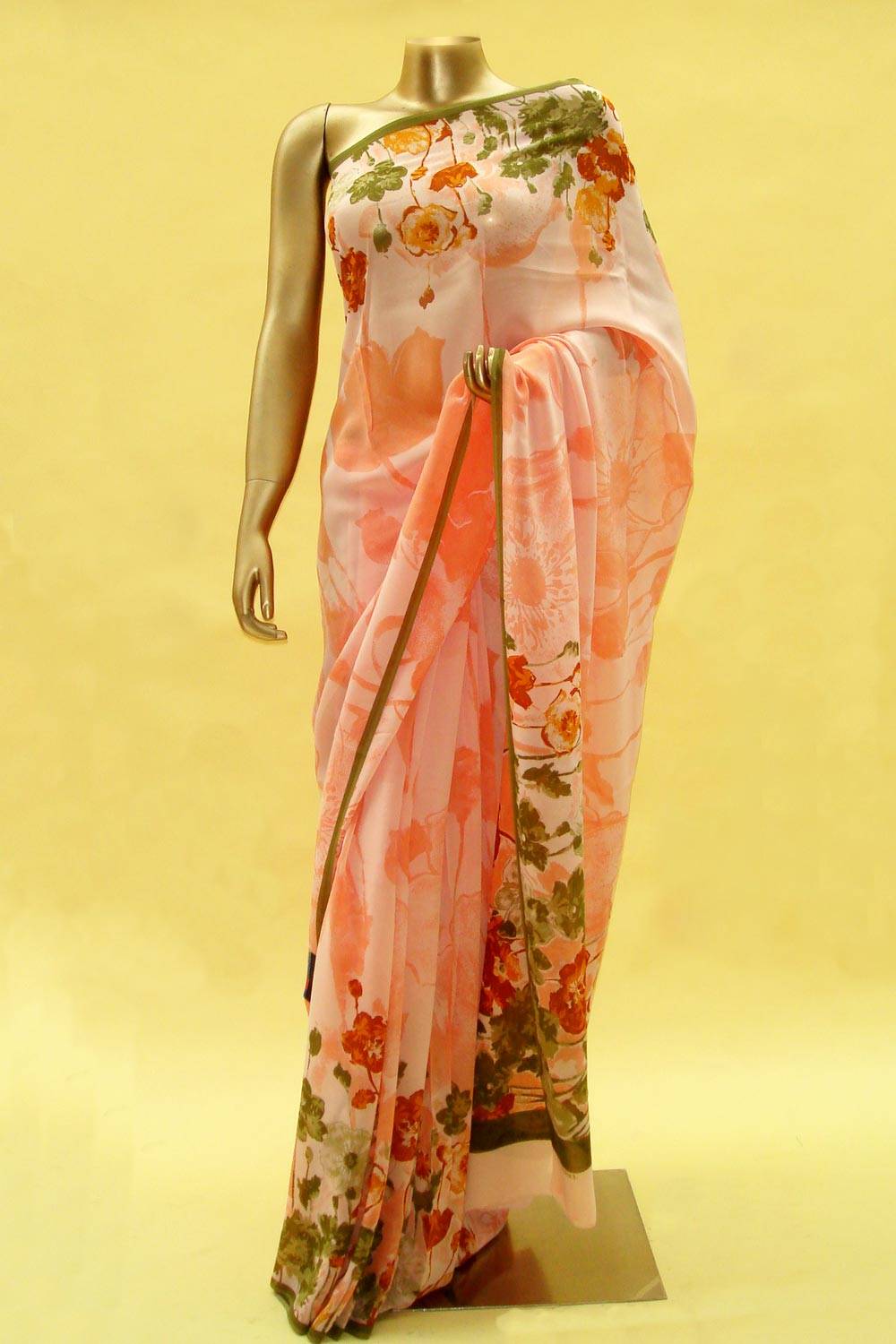 The sari is usually worn over a petticoat, with a blouse known as a choli or ravika forming the upper garment. The choli has short sleeves and a low neck and is usually cropped, and as such is particularly well-suited for wear in the sultry South Asian summers. Cholis may be backless or of a halter neck style. These are usually more dressy with plenty of embellishments such as mirrors or embroidery, and may be worn on special occasions. Women in the armed forces, when wearing a sari uniform, don a short-sleeved shirt tucked in at the waist. The sari developed as a garment of its own in bothSouth and North India at around the same time, and is in popular culture an epitome of Indian culture.
The word sari is derived from Sanskrit शाटी śāṭī which means 'strip of cloth'. This became शाडी śāḍī or साडी sāḍī in Prakrit, and then sāṛī in Hindi.
In the history of Indian clothing the sari is traced back to the Indus Valley Civilisation, which flourished during 2800-1800 BCE around the western part of the Indian subcontinent. The earliest known depiction of the sari in the Indian subcontinent is the statue of an Indus Valley priest wearing a drape.
Ancient Tamil poetry, such as the Silappadhikaram and the Kadambari by Banabhatta, describes women in exquisite drapery or sari.In ancient Indian tradition and the Natya Shastra (an ancient Indian treatise describing ancient dance and costumes), the navel of the Supreme Being is considered to be the source of life and creativity, hence the midriff is to be left bare by the sari.

 Sculptures from the Gandhara, Mathura and Gupta schools (1st-6th century AD) show goddesses and dancers wearing what appears to be a dhoti wrap, in the "fishtail" version which covers the legs loosely and then flows into a long, decorative drape in front of the legs. No bodices are shown.
Other sources say that everyday costume consisted of a dhoti or lungi (sarong), combined with a breast band and a veil or wrap that could be used to cover the upper body or head. The two-piece Kerala mundum neryathum (mundu, a dhoti or sarong, neryath, a shawl, in Malayalam) is a survival of ancient Indian clothing styles. The one-piece sari is a modern innovation, created by combining the two pieces of the mundum neryathum.
It is generally accepted that wrapped sari-like garments, shawls, and veils have been worn by Indian women for a long time, and that they have been worn in their current form for hundreds of years.
 One point of particular controversy is the history of the choli, or sari blouse, and the petticoat. Some researchers state that these were unknown before the British arrived in India, and that they were introduced to satisfy Victorian ideas of modesty. Previously, women only wore one draped cloth and casually exposed the upper body and breasts. Other historians point to much textual and artistic evidence for various forms of breastband and upper-body shawl.

In Kerala and Tamil Nadu, it is indeed documented that women from many communities wore only the sari and exposed the upper part of the body till the 20th century.Poetic references from works like Silappadikaram indicate that during the sangam period in ancient Tamil Nadu, a single piece of clothing served as both lower garment and head covering, leaving the bosom and midriff completely uncovered. In Kerala there are many references to women being bare-breasted, including many pictures by Raja Ravi Varma. Even today, women in some rural areas do not wear cholis.

Saris are woven with one plain end (the end that is concealed inside the wrap), two long decorative borders running the length of the sari, and a one to three foot section at the other end which continues and elaborates the length-wise decoration. This end is called the pallu; it is the part thrown over the shoulder in the nivi style of draping.
In past times, saris were woven of silk or cotton. The rich could afford finely-woven, diaphanous silk saris that, according to folklore, could be passed through afinger ring. The poor wore coarsely woven cotton saris. All saris were handwoven and represented a considerable investment of time or money.
Simple hand-woven villagers' saris are often decorated with checks or stripes woven into the cloth. Inexpensive saris were also decorated with block printingusing carved wooden blocks and vegetable dyes, or tie-dyeing, known in India as bhandani work.
More expensive saris had elaborate geometric, floral, or figurative ornaments or brocades created on the loom, as part of the fabric. Sometimes warp and weft threads were tie-dyed and then woven, creating ikat patterns. Sometimes threads of different colors were woven into the base fabric in patterns; an ornamented border, an elaborate pallu, and often, small repeated accents in the cloth itself. These accents are called buttis or bhuttis (spellings vary). For fancy saris, these patterns could be woven with gold or silver thread, which is called zari work.

Sometimes the saris were further decorated, after weaving, with various sorts of embroidery. Resham work is embroidery done with colored silk thread. Zardoziembroidery uses gold and silver thread, and sometimes pearls and precious stones. Cheap modern versions of zardozi use synthetic metallic thread andimitation stones, such as fake pearls and Swarovski crystals.
In modern times, saris are increasingly woven on mechanical looms and made of artificial fibers, such as polyester, nylon, or rayon, which do not require starching or ironing. They are printed by machine, or woven in simple patterns made with floats across the back of the sari. This can create an elaborate appearance on the front, while looking ugly on the back. Thepunchra work is imitated with inexpensive machine-made tassel trim.
Hand-woven, hand-decorated saris are naturally much more expensive than the machine imitations. While the over-all market for handweaving has plummeted (leading to much distress among Indian handweavers), hand-woven saris are still popular for weddings and other grand social occasions.
Sunday, July 11, 2010

Subscribe to:
Posts (Atom)